One of our teammates has a parent who is a school teacher who faces the challenge of students experiencing epileptic seizures in class. Teachers can't constantly monitor and prevent every incident. We wanted to build something proactive. The core idea of using crossed polarized lenses was inspired by a workshop at the Institute for Quantum Computing at the University of Waterloo.
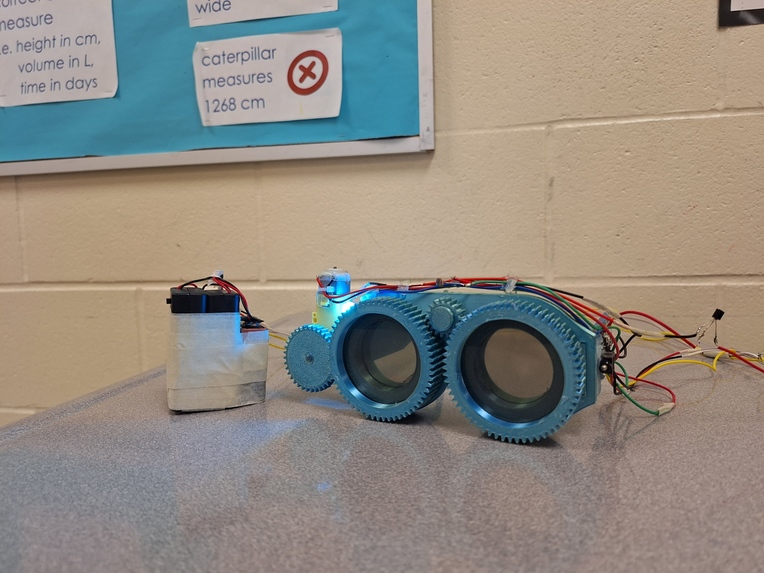
StrobeShield is a pair of glasses that prevents photosensitive seizures by detecting flashing lights and mechanically blocking them. A photoresistor continuously monitors ambient light; when the Raspberry Pi Pico detects a dangerous strobe frequency (5–30 Hz), it drives a DC motor that rotates polarized lenses over fixed polarized lenses, crossing their axes and blacking out the light within 155 ms.
Beyond the hardware, the system includes a web app that logs each detected epileptic incident with a timestamp, and an automated SMS system that immediately alerts parents when a seizure event is triggered.
After numerous frame iterations, the final design was modelled in SolidWorks and 3D printed in silk PLA. The frame uses a classic glasses silhouette with two gears surrounding each lens and a central synchronizing gear. Four polarized lenses are used: two are fixed, and two rotate with the gears to cross the polarization axis. A DC motor mounted on the side drives the mechanism on detection.
On the firmware side, we wrote an algorithm on the Pico to interpret photoresistor readings and flag dangerous flash frequencies. A web app was built to log seizure history from the Pico, and an automated SMS pipeline was integrated to notify parents in real time.
- Lens misalignment during assembly required multiple gluing iterations to get right
- The device stopped working in the final hour of the hackathon despite passing all earlier tests
For most of the team this was our first in-person hackathon. We went deep on Raspberry Pi, circuitry, and soldering while also learning how to scope a hardware project under extreme time pressure. The biggest takeaway was how much the team's different skills complimented each other; the mechanical design, firmware, and web layers all had to come together in one day.
- The gear-driven polarized lens mechanism worked smoothly after countless hours of 3D design and prototyping iterations
- The photoresistor algorithm reliably detects dangerous flash frequencies and triggers the lens rotation
- The full circuit system with hand-soldered connections held up through testing
- Won Best Hardware Hack at EurekaHACKS
Planning a seizure prediction feature using a TensorFlow model trained on ECG and epilepsy datasets, enabling the glasses to anticipate events before a flash even occurs.