
Running thermal simulations of Laser Powder Bed Fusion (LPBF) builds in Simufact Additive, using predicted thermal histories to model residual stress and distortion after EDM removal from the build plate.
Applying distortion compensation by pre-deforming part geometry from simulation results so parts spring back to nominal shape after release.
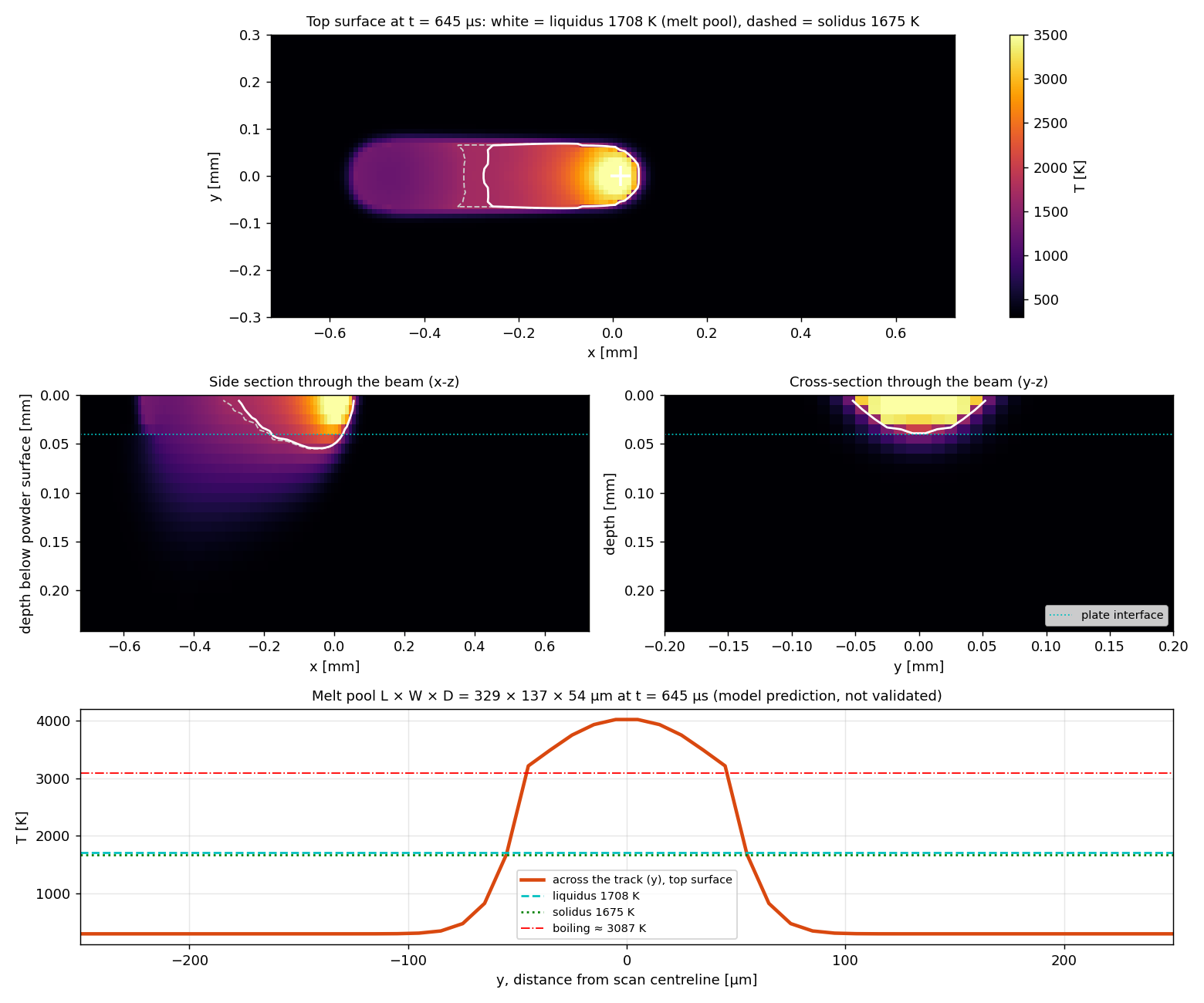
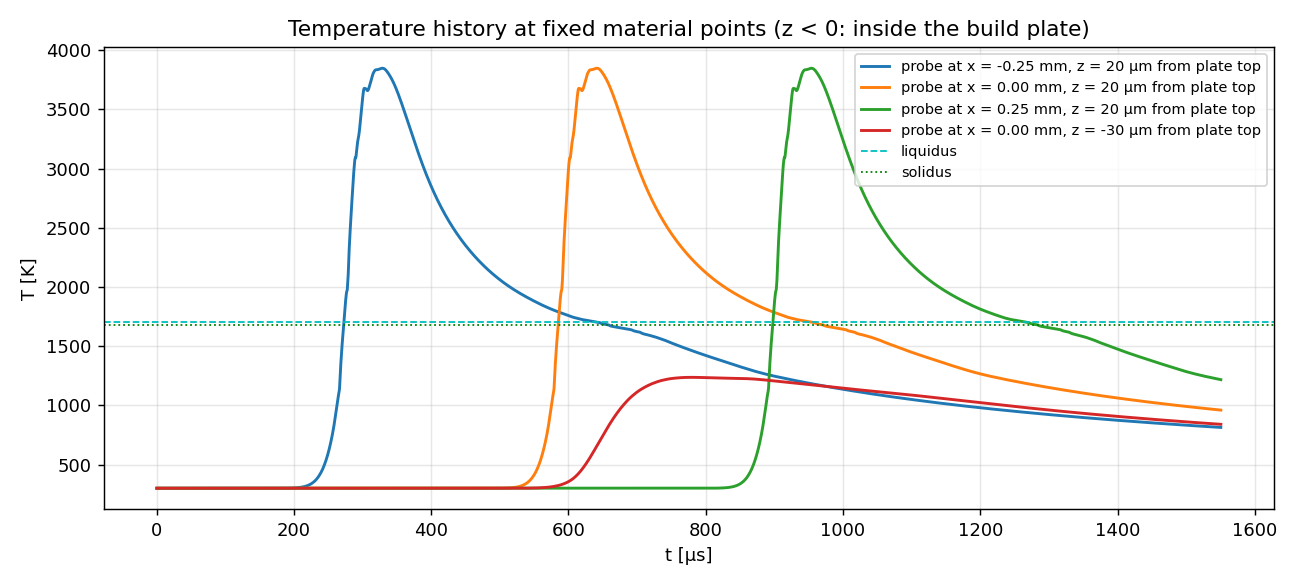
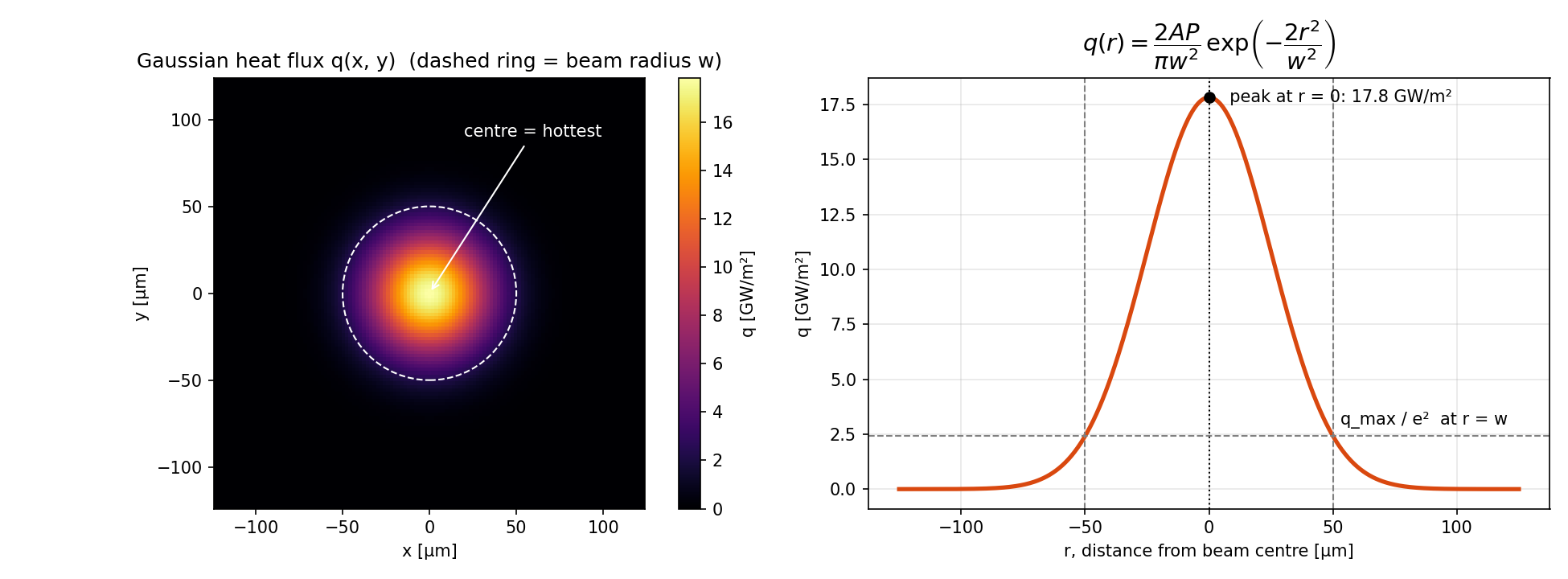
To understand what the commercial solver does under the hood, I wrote my own transient 3D thermal model of a Gaussian laser scanning a 316L powder layer (images above). It is an enthalpy-form finite-volume solver with temperature-dependent 316L properties, latent heat, powder conductivity, shielding-gas convection, radiation and evaporation, with a browser port that matches the Python reference to ~1e-11.
It exports per-cell thermal histories (peak T, cooling rate, G and R at solidification) as input for a residual-stress model.